

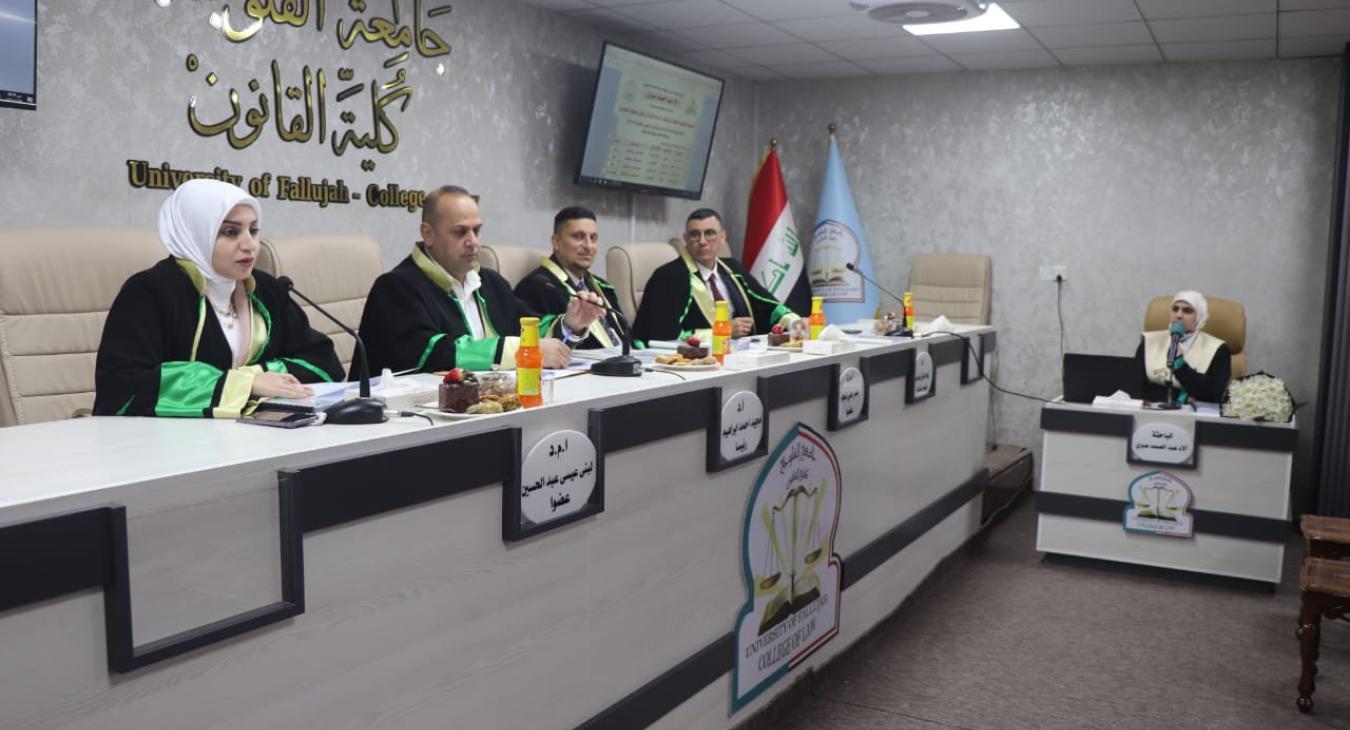
A master’s thesis at the College of Law discussing the legal nature of digital blocks. With the blessing of God Almighty, the College of Law at the University of Fallujah discussed on Thursday, January 23, 2025, a master’s thesis in private law, tagged ((The Legal Nature of Digital Blocks - A Comparative Study in Intellectual Property Rights)) and submitted by Master’s student Alaa Abdel Samad Sabry. The study dealt with the subject of the legal nature of digital block technology, and it aimed to identify the nature of this technology, adapt it according to known legal rules, and the extent to which it can be considered a means of protecting and managing rights. The author, in terms of its authority in proof and enabling the author to exercise his rights over his work and to know the obstacles he faces in the field of copyright. The study used the comparative analytical approach, as the study reached, after tracing references and extrapolating legal texts, to the conclusion that digital block technology represents a special system that is difficult to include under the concept of works. It is also considered one of the latest technologies, which is currently used in several fields, including copyright, as it has a major role in managing and protecting copyright, due to its unique characteristics. Among the characteristics that distinguish it from other means are in terms of decentralization, open record, and inability to delete or modify, as it contributes effectively to providing management and protection of copyright at the lowest cost, despite the obstacles that surround it in terms of its incompatibility with existing legal frameworks, which hinders its official adoption. The study recommended adopting this technology within intellectual property legislation in order to end the state of legislative vacuum that hinders the adoption of this technology, and the necessity of legislative intervention within the laws of evidence and the law of signature. Electronic and electronic transactions to demonstrate the validity of digital block technology in proof, as well as urging digital rights management systems and collective management bodies to benefit from digital block technology in enhancing their role in the field of copyright management. The discussion committee consisted of: Prof. Dr. Majeed Ahmed Ibrahim, Chairman, Prof. Dr. Lubna Issa Abdul Hussein, Member, Prof. Dr. Omar Ali Najm, Member, Prof. Dr. Ziad Tariq Jassim, Member. My supervisor, after extensive study of the thesis and the discussion committee hearing the student’s defenses for her thesis, the committee decided to accept the thesis and grant the student a master’s degree. A thousand congratulations to the student for this effort she has made, and may she pursue her doctorate, God willing. Media Division/College of Law