
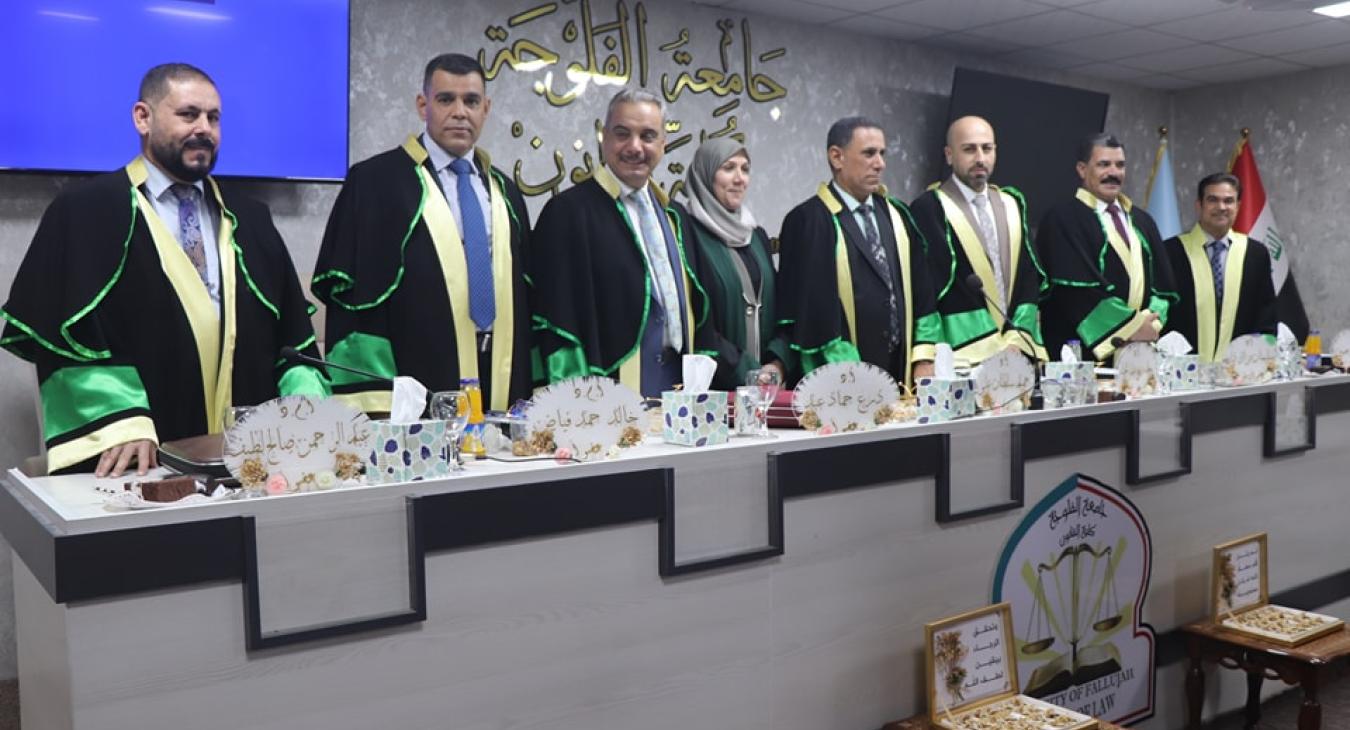
A doctoral thesis at the College of Law, University of Fallujah, discussing the provisions of the absent in Islamic Sharia and law. With the blessing of God Almighty. On Thursday, April 18, 2024, the College of Law discussed a doctoral thesis in private law, tagged ((Provisions of the absent in Islamic Sharia and law)) and submitted by the doctoral student (Umm Kulthum Sabih Muhammad). Researching the rulings on the absent is one of the important topics because of the problems it raises. In the arenas of judiciary and law, and before them in the arena of Islamic jurisprudence, regardless of its different schools of thought, because the absent person, as a person in society, is naturally a party to many different legal actions before or during his absence. The study dealt with the fate of those actions and explained how to preserve the money he left behind, as well as explaining the legal system to which the absent person is subject, while clarifying the fate of the absent person’s marriage and the effects and obligations resulting from him if he were married. The importance of the study was demonstrated in trying to bring the two destinations closer together. He looked at Islamic jurisprudence and positive law to narrow the scope of any disagreement that may appear between them in light of the developments of the times and the requirements of reality, and to arrive at answers to all the questions that could be asked about the provisions on the actions of the absent person, regardless of the type of those actions, whether related to the personal side or the financial side. The thesis was divided into two sections, the first of which is a theoretical section to clarify what is meant by the absent person and the conditions that must be met to count the person as absent, along with an explanation of the legislative origin for regulating those provisions, while the second section was devoted to clarifying Detailed provisions for the financial and personal actions of the absentee. The study concluded with a set of conclusions and recommendations, perhaps the most prominent of which is the call to amend the definition of the absentee, as well as to reformulate some texts of the amended Iraqi Personal Status Law No. 188 of 1959 and the Care of Minors Law No. 78 of 1980, with the necessity of explicitly stipulating in the Iraqi Civil Law No. 40 of 1951 that absence be counted as a legal disability. The discussion committee consisted of: :Mr. Dr. Hamid Sultan Ali, Chairman, Dr. Shield Hammad Abd, member, Dr. Saad Rabie Abdul Jabbar, member, MD. Khaled Hamad Fayyad, member, MD. Abdul Rahman Saleh Latif, member, Dr. Adel Nasser Hussein, member and supervisor, Dr. Suleiman Barak Dayeh, member and supervisor. After extensive study of the thesis and the discussion committee hearing the student’s defenses of her thesis, the committee decided to accept it and grant the student a doctorate. A thousand congratulations to the student for this effort she has made and to further progress and scientific excellence, God willing. Media Division / College of Law